
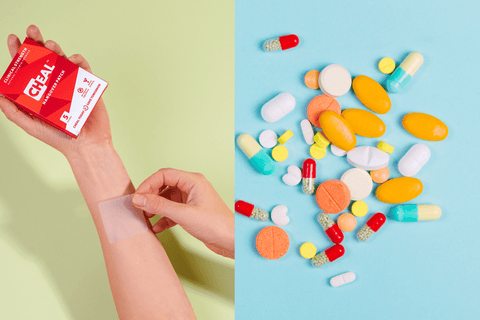
Short answer: it depends on the ingredient, and the research is still early. Some compounds pass through the skin well, many vitamins don't, and the few studies that compared patches with pills found pills did better. A patch is a convenient, hands-off way to take a supplement on a night out. It isn't a replacement for water, food and pacing yourself.
How vitamins get through the skin
A transdermal patch holds its ingredients against your skin so they can reach the bloodstream without going through your stomach. To get there, a compound has to cross the stratum corneum, the skin's tough outer layer, and reach the small blood vessels in the layer below.
Small, fat-soluble molecules cross most easily. That's why nicotine and some hormones are reliably delivered by patch. Many vitamins are larger or water-soluble, so they pass through less readily unless the formula is designed to help them.
What the research says
- Patches vs. pills: a 2021 review found only two human trials comparing the two, and the pill group did better in both. People using multivitamin patches after weight-loss surgery had more vitamin deficiencies after a year than people taking oral supplements, and runners using iron patches had lower iron stores than runners taking iron by mouth.1
- Vitamin D: in a 2022 study of 30 healthy adults, a vitamin D patch worn for 8 weeks raised average blood levels, and no one was deficient by the end. The study didn't include a pill group to compare against.2
- Hangover patches: no clinical trials have tested hangover patches as a product. Their ingredients are chosen from what's known about each one on its own.
The honest summary: skin delivery can work for some ingredients, but it hasn't been shown to match pills for vitamins.
Patches vs. pills at a glance
| Patch | Pill | |
|---|---|---|
| How it's absorbed | Through the skin, gradually | Through the digestive system |
| When you take it | Once, before your first drink, worn 8–12 hours | Before, during or after drinking, sometimes in several doses |
| Speed | Slow, steady release | Faster, over a shorter window |
| With an upset stomach | Nothing to swallow | Can be hard to keep down |
| Research | Limited, and mixed | Better studied for most vitamins |
When a patch makes sense
- You'd rather not swallow pills, especially on a night out.
- You want something you put on once and forget about overnight.
- Your stomach is sensitive when you drink.
When a pill may suit you better
- You want a vitamin that's well studied in oral form.
- You're happy to remember doses at the right time.
- You're treating a diagnosed deficiency. Ask your doctor which form to use.
What to check before you buy a patch
- Ingredient amounts: the label should list every ingredient and how much of each is in one patch.
- Where it's made: look for the country of manufacture and any third-party testing.
- Realistic claims: be wary of any patch that promises to prevent or cure a hangover. No supplement can.
- Your health: if you're pregnant, breastfeeding, taking medication or have a medical condition, check with your doctor first.
How Cheal fits in
Cheal is a clear, latex-free hangover patch with seven ingredients: vitamin B1 and a vitamin B complex, the antioxidants glutathione and NAC, and the plant extracts DHM, milk thistle and green tea extract. The amount of each is listed on the product page, and How Cheal works explains why each one is included. You put one on about 30 minutes before your first drink and wear it for 8 to 12 hours.
The bottom line
Vitamin patches are a convenient format with real limits. Some ingredients absorb through the skin, many vitamins absorb better as pills, and the research is still early. If you like the idea of a patch, choose one that lists its amounts, and keep drinking water, eating and pacing yourself. Nothing replaces those.
References
- Grammatikopoulou MG, Gkiouras K, Dardiotis E, et al. Peeking into the future: transdermal patches for the delivery of micronutrient supplements. Metabolism Open. 2021;11:100109. PMC8318979
- Jefferson A, Borges C. Evaluation of the safety, tolerability and plasma vitamin D response to long-term use of patented transdermal vitamin D patches in healthy adults. 2022. PMC9813629

